
12555 Orange Drive
Suite 233
Davie, FL 33330
12555 Orange Drive
Suite 233
Davie, FL 33330
In this article, you will discover:
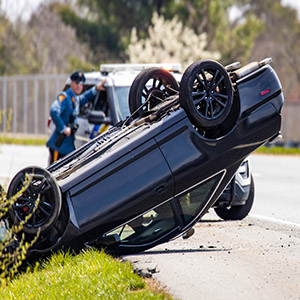
If your vehicle rolls over, you’re probably going to be upside down. Stay calm and pause for a minute to collect yourself. When you’re ready:
Once you realize what happened and you’ve determined it’s safe to do so, immediately exit the vehicle, especially if you smell gas or your car is on fire. However, you first want to ensure you’re not putting yourself in further danger.
Once you’re out of the vehicle, call 911 if someone hasn’t already. 911 will dispatch paramedics and the police.
When the paramedics arrive, you want them to examine you, even if you feel okay. Because your adrenaline is pumping from the crash and rollover incident, you may feel no pain, and injury may not be your primary concern. That’s a mistake.
Rollovers can cause internal injuries, traumatic brain injury, whiplash or herniated discs. Your injuries may seem minor at the crash scene, but they can become serious later. What presents as a sprain and strain may develop into an injury that doesn’t heal. That’s why you want your injuries evaluated and documented immediately following a rollover crash.
If possible, before you are transported, take photographs of the crash and the accident scene. If a picture is worth a thousand words, photos showing your vehicle upside down will tell the story of a severe impact and crash. A severe impact and crash constitute significant value for purposes of settlement.
Typically, the bigger the crash, the bigger the settlement. That’s why you want to document the scene with photographs, including tire marks or damage to the property the vehicle hit.
Get the names and contact information of any witnesses at the crash scene. Later, you may want to speak with those witnesses to help build your case.
A personal injury attorney can:
Personal injury attorneys generally work on a contingency fee basis, which means there’s no cost unless they recover money for you.
That inquiry begins by gathering the facts of the case. For example, you want to determine who crossed the center line or entered the wrong lane. To do that, you look at the police report to determine who violated what traffic law and created the dangerous condition that led to the crash.
The most common cause of head-on crashes is distracted driving. For example, you’re texting while driving on a two-lane road and cross the center line, which is a traffic violation, and that causes a head-on crash.
Other common causes include fatigued driving, impaired driving or simply speeding and not paying attention. Perhaps you’re speeding around a curve, take it too fast, and end up hitting another driver head-on.
To determine who’s at fault, you review the evidence, including witness statements and the 911 audio. That audio provides the caller’s immediate description of what happened following the crash. That can ultimately be used as evidence to support a case of who’s at fault in a collision.
Another form of evidence used is dash cam video. More people have dash cams today because they are cheaper than they used to be. Dash cam video is helpful for head-on crashes because it’s usually pointed straight ahead, where the point of impact would occur.
In a head-on collision, the vectors of the forces interact straight on. There are no other ways in which the vectors can be directed to reduce the impact.
The laws of physics tell us that head-on impacts are powerful. If you’re able to prove that the other driver is at fault in a head-on collision, these are generally better cases for recovery of damages.

Attorney Micah Longo is a skilled lawyer based in Davie, Florida, who has helped many clients like you navigate the intricacies of personal injury law. With more than two decades of experience, he is prepared to assist you in pursuing your head-on, T-bone or rollover collision claim so you receive the maximum compensation for your pain, suffering, lost wages and injuries.
Still have questions? Ready to get started? Contact The Longo Firm today to schedule an initial consultation.
T-bone or side-impact crashes typically occur when a driver fails to yield the right-of-way. In any intersectional accident involving a side impact, one driver has the right-of-way, and the at-fault driver does not.
T-bone crashes are often caused by distracted or reckless driving. For example, someone may run a red light because they’re texting or looking at their phone.
Maybe the light was green when the driver looked down at their phone for a second and then turned yellow or red. Suddenly, the driver enters the intersection and collides at full speed with the driver who has the right of way.
T-bone crashes are high-level collisions because the forces are perpendicular. The vectors and the forces are side-to-side, which can cause significant injury. They can also cause rollover crashes because the forces can be so strong that the struck vehicle rolls onto its side.
Every case is different, and compensation for head-on collisions can vary widely depending on specific factors:
Assuming fault isn’t an issue, you first want to assess the severity of the injuries. In personal injury law, the more significant the injury, the more value the case has. It’s a double-edged sword in that respect: while you never want someone to be hurt badly, the more hurt you are, the more your case is worth.
Another factor in determining the case’s value is the extent of property damage. Property damage gives you an idea of the severity of the impact and the amount of force moving through the vehicle at high speed.
Just because there’s not much visible property damage doesn’t mean the crash is insignificant. There are many cases of severe impact where one car is absolutely destroyed while the other is lightly damaged.
When you’re considering the severity of the impact and the damage it caused, you’re looking at the internal forces on the vehicle, not its outward appearance. For instance, you’re more interested in whether the vehicle’s steel frame was damaged than in whether the bumper was torn up. While there may not be much “visible property damage,” the specific concern is whiplash.
The final factor determining compensation in head-on collisions is insurance coverage. The more coverage available, the greater the value of a case.
Victims of head-on collisions are entitled to two types of compensation
There are different types of economic damages you’re entitled to in a head-on collision, including:
Economic damages are generally the easiest to understand, prove and put a value on. You simply submit your medical bills and evidence of what you’ve lost or will lose.
Non-economic damages are more problematic. They relate to injuries you can’t see from the outside, including:
In Florida, there’s a jury instruction that permits damages for loss of enjoyment of life and inconvenience. For example, you can be awarded damages for the extensive time lost due to doctors’ office appointments and treatment.
Regarding compensation for head-on collisions, every case is different, but there are typical ranges:
Ultimately, every case is different. You can have a head-on collision that results in a minor soft tissue case, while another head-on collision kills people.
For more information on serious vehicle collisions in Florida, an initial consultation is your next best step. Get the information and legal answers you are seeking by calling (954) 231-5802 today.
Attorney Micah Longo is a skilled lawyer based in Davie, Florida, who has helped many clients like you navigate the intricacies of personal injury law. With more than two decades of experience, he is prepared to assist you in pursuing your head-on, T-bone or rollover collision claim so you receive the maximum compensation for your pain, suffering, lost wages and injuries.
Still have questions? Ready to get started? Contact The Longo Firm today to schedule an initial consultation.